
GEOPOLITICAL COMMENTARY
The United Kingdom Under Andy Burnham: Political Transition, Economic Outlook, and Strategic Implications

Executive Assessment
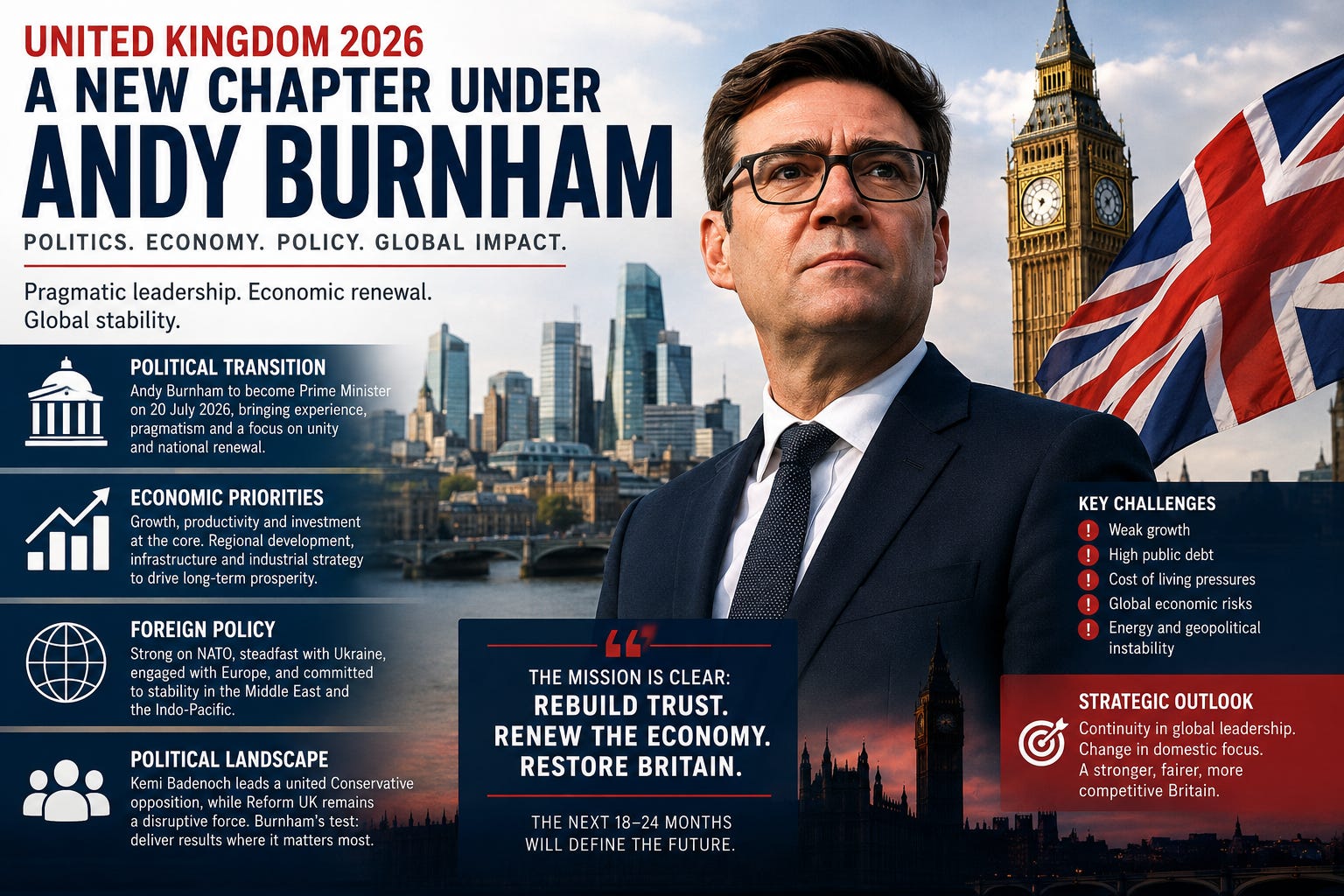
The United Kingdom is entering another significant political transition, with Andy Burnham expected to assume office as Prime Minister on Monday, July 20. Unlike previous leadership changes driven by acute crises, Burnham inherits a government facing structural economic challenges rather than an immediate constitutional or financial emergency.
His administration is expected to pursue continuity in foreign and security policy while introducing more activist domestic economic policies, particularly around regional development, industrial strategy, and public service reform. The principal determinant of his political success will be economic performance rather than ideological appeal.
Political Environment
Burnham enters office with stronger personal credibility than many recent prime ministers.
His reputation as Mayor of Greater Manchester has cultivated an image of pragmatic leadership, competence, and regional renewal. However, he does not enjoy an overwhelming electoral mandate, and will need to convert his personal popularity into measurable economic outcomes.
Unlike previous transitions, markets have remained relatively calm, reflecting expectations of policy continuity rather than radical change.
Assessment
Political stability is expected to improve modestly during the first year of the Burnham government, although Britain's underlying electoral volatility remains.
Domestic Policy Direction
There are several policy themes emerging with respect to the domestic economy. As such, the Burnham administration is expected to prioritize regional economic rebalancing, greater devolution to English cities, infrastructure investment, support for strategic industries, NHS and public service reform, as well as fiscal discipline even in the face of increased public investment.
Rather than pursuing large-scale ideological reforms, Burnham is likely to govern from the centre-left.
Economic Outlook
The economy represents the government's greatest strategic vulnerability. Its key challenges include weak productivity growth, high public debt, limited fiscal space, persistent cost-of-living pressures, and slowing private investment.
Even though inflation has moderated, economic growth remains subdued. Therefore, Burnham faces a tough balancing act between stimulating growth and maintaining market confidence.
Opportunities
If successful, investment in transport, manufacturing, clean energy, and regional infrastructure could improve Britain's medium-term competitiveness.
Risks
The greatest risks to the Burnham administration include:
• Global economic slowdown.
• Renewed energy price shocks resulting from Middle East instability.
• Rising borrowing costs.
• Declining investor confidence, if fiscal discipline weakens.
On Foreign Policy
No major strategic realignment is anticipated. Britain is expected to continue:
• Strong NATO commitments.
• Military and financial support for Ukraine.
• Close intelligence cooperation with the United States.
• Strategic engagement with Europe.
• Maritime security operations in the Gulf and Red Sea.
Where a change may emerge is in diplomatic style rather than strategic objectives. Burnham is expected to place greater emphasis on multilateral diplomacy and conflict de-escalation while maintaining Britain's existing security commitments.
Middle East
Burnham is unlikely to significantly reduce British involvement in the Middle East. Instead, Britain is expected to continue supporting maritime security, maintain intelligence cooperation with Gulf partners, advocate diplomatic de-escalation, and avoid direct military escalation unless British interests are threatened.
The UK is therefore likely to remain an influential secondary actor rather than the principal driver of regional diplomacy.
Conservative Opposition
Kemi Badenoch is expected to pursue a strategy of constructive opposition. This means supporting government policy where national security is involved while strongly opposing the Labour Party's domestic agenda.
Areas likely to receive bipartisan support include defence spending, NATO, Ukraine, counter-terrorism, and intelligence capabilities.
Likely areas of political confrontation by the Conservative party will include taxation, industrial policy, public expenditure, state intervention, labour relations, and immigration.
The Conservatives are also under pressure from Reform UK, forcing Badenoch to defend Conservative voters from further defections while rebuilding credibility as the principal opposition party.
Political Risks
Burnham's government faces four (4) principal risks:
• Economic credibility
Failure to generate growth could rapidly erode public confidence.
• Fiscal pressure
Growing demands on healthcare, pensions, and infrastructure could constrain policy flexibility.
• Party management
Balancing Labour's progressive and centrist wings will likely remain challenging.
• Electoral competition
Pressure from both the Conservatives and Reform UK could fragment the opposition vote while limiting Labour's room for policy manoeuvre.
Strategic Outlook (2026–2028)
The United Kingdom is unlikely to undergo a fundamental strategic transformation under Burnham. Instead, the period is expected to be characterised by:
• Moderate economic intervention
• Fiscal pragmatism
• Stable foreign policy
• Continued defence commitments
• Strong regional investment
• Increased emphasis on industrial resilience
If economic growth improves over the next 18–24 months, Burnham could consolidate Labour's position and restore a degree of political stability after years of leadership turnover.
If growth remains weak or external shocks—particularly from the Middle East or global financial markets—intensify, Britain could once again enter a period of political instability.
Intelligence Judgement
Probability of policy continuity: High, 85–90 percent
Probability of significant economic reform: Moderate, 60–70 percent
Probability of major foreign policy realignment: Low, 20–30 percent
Probability that the economy determines Burnham's political survival: Very high, 90 percent
Bottom Line
Andy Burnham is expected to govern as a pragmatic centre-left leader, emphasizing economic renewal over ideological transformation. The UK's global role is likely to remain broadly consistent, with continuity in defence and foreign policy.
The defining question of Burnham's premiership will not be whether he changes Britain's strategic direction, but whether he can reverse years of weak growth, restore confidence in public services, and deliver tangible improvements in living standards.
From a geopolitical perspective, Britain's external posture should remain stable, while its domestic economic performance will increasingly determine its influence abroad.