
Situation Report, SITREP
US–Iran Ceasefire Collapse

Date: 16 July, 2026
Executive Summary
The US–Iran ceasefire has effectively broken down following renewed military strikes by both sides. While neither Washington nor Tehran appears to be pursuing a full-scale war, both are engaged in calibrated military operations intended to improve their strategic leverage. The Strait of Hormuz remains the principal flashpoint, with significant implications for global energy markets and regional security.
Operational Overview
United States
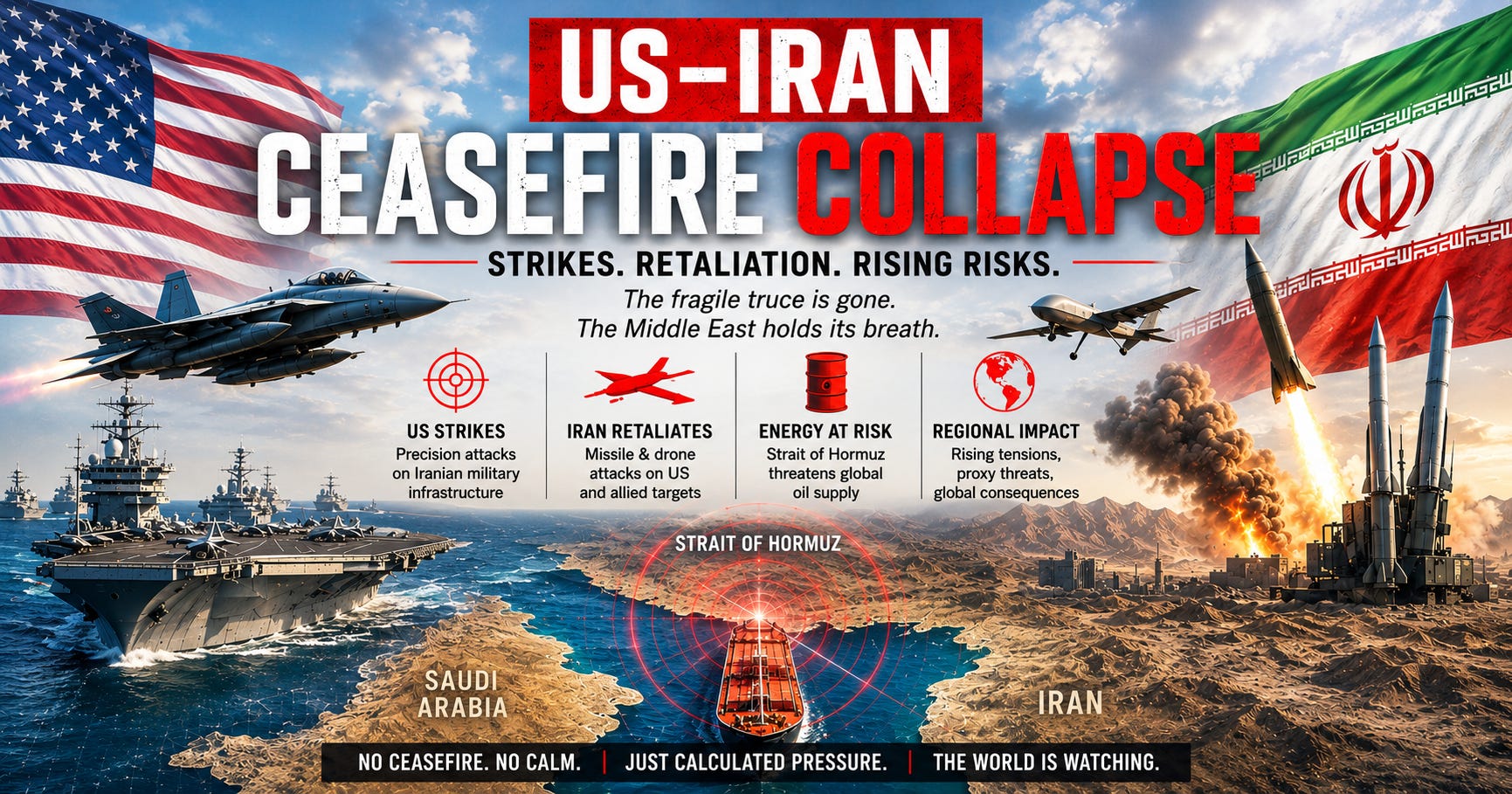
• Conducted additional precision strikes against Iranian military facilities and missile infrastructure.
• Increased naval and air force readiness in the Persian Gulf.
• Reinforced air and missile defense systems across regional bases.
Iran
• Launched missile and drone attacks targeting US military installations and allied facilities in the Gulf.
• Continued to threaten disruption of maritime traffic through the Strait of Hormuz.
• Elevated the readiness of the Islamic Revolutionary Guard Corps (IRGC) and coastal defense units.
Strategic Assessment
The conflict remains in a controlled escalation phase. Both governments are attempting to impose military costs without crossing thresholds that would trigger a prolonged regional war.
Indicators of Further Escalation
• Additional US strikes on Iranian command-and-control or nuclear-related facilities.
• Iranian attempts to interfere with commercial shipping in the Strait of Hormuz.
• Increased attacks by Iran-aligned proxy groups against US or partner interests in Iraq, Syria, Lebanon, and Yemen.
• Mobilization of additional US carrier strike groups or strategic bombers.
Indicators of De-escalation
• Renewed indirect negotiations through regional mediators such as Oman or Qatar.
• Reduction in cross-border strikes.
• Humanitarian or prisoner exchange agreements.
• Public statements signaling willingness to resume ceasefire negotiations.
Energy Security Impact
• Elevated risk premiums for oil transported through the Strait of Hormuz.
• Increased volatility in global crude oil markets.
• Potential delays in commercial shipping and higher maritime insurance costs.
• LNG exports from Qatar remain vulnerable to any sustained disruption.
Regional Outlook (Next 7–14 Days)
Probability Assessment
Controlled military exchanges: High, 70 percent
Limited regional expansion involving proxy groups: Moderate, 50 percent
Major regional war involving multiple states: Low to Moderate, 25 percent
Diplomatic re-engagement: Moderate, 45 percent
Intelligence Outlook
The current trajectory suggests that both Washington and Tehran seek to maintain military pressure while avoiding a direct, large-scale conflict. However, the operating environment is highly volatile, and a single miscalculation, particularly in the Strait of Hormuz or involving US regional assets, could rapidly escalate into a broader Middle East crisis. Continuous monitoring of naval deployments, proxy activity, and diplomatic back-channels remain essential.